
Custom ERP Software Development: Building Intelligent, Scalable Business Systems
March 04, 2026•SquareX Team•TechnologyModern enterprises increasingly invest in custom ERP software development to align technology with unique workflows, data structures, and long-term strategy in an AI-driven world.
Enterprise complexity is increasing faster than most legacy systems can handle. Static ERP platforms built for predictable operations struggle to keep pace with AI-driven decision-making, cloud-native infrastructure, and real-time analytics.
Modern enterprises cannot rely on rigid, one-size-fits-all platforms. As operations grow more complex, businesses increasingly invest in custom ERP software development to align technology with their unique workflows, data structures, and long-term strategy.
Unlike off-the-shelf systems, custom ERP development delivers tailored functionality, seamless integrations, and scalable architecture designed specifically for organizational needs — similar to how businesses evaluate a scalable web tech stack when building high-performance applications.
Today, with the rise of AI-driven ERP systems and cloud infrastructure, businesses are moving beyond traditional ERP servers toward intelligent, adaptable, and SaaS-based ecosystems. This guide explains how custom ERP software development strengthens operational control, enhances automation, and positions enterprises for sustainable growth.
What Is Custom ERP Software Development?
Custom ERP software development refers to designing and building an enterprise resource planning system tailored to a company’s internal processes, industry requirements, and scalability goals.
Instead of adapting workflows to prebuilt software, businesses implement custom ERP development strategies that reflect their operational model. A well-architected ERP system centralizes:
- Finance and accounting
- Supply chain management
- Inventory control
- Human resources
- Customer relationship management
- Data analytics
With AI-driven ERP systems, organizations can integrate predictive insights, automation workflows, and intelligent reporting directly into their ERP framework.
Why Businesses Choose Custom ERP Software Development
Off-the-shelf ERP platforms often introduce unnecessary complexity, feature overload, or integration limitations. Custom ERP software development eliminates these constraints and aligns technology directly with operational strategy.
Strategic Advantages
- Full control over system architecture
- Industry-specific workflow alignment
- Scalable ERP servers infrastructure
- Seamless third-party integrations
- Enhanced data security
- Long-term cost optimization
Custom ERP software development ensures the system grows alongside the business instead of limiting innovation.
AI-Driven ERP Systems: The Future of Enterprise Operations
Modern enterprises demand intelligence, not just automation. AI-driven ERP systems enhance traditional ERP capabilities by introducing predictive analytics, anomaly detection, and continuous optimization.
AI enhances custom ERP software development through:
- Predictive demand forecasting
- Automated financial reconciliation
- Intelligent inventory management
- Real-time anomaly detection
- Data-driven strategic planning
By integrating AI from the beginning, custom ERP development transforms ERP systems into proactive decision-making platforms rather than reactive data repositories. In forward-looking organizations, ERP becomes the operational brain — not just the reporting engine.
Custom ERP Software Development Strategy
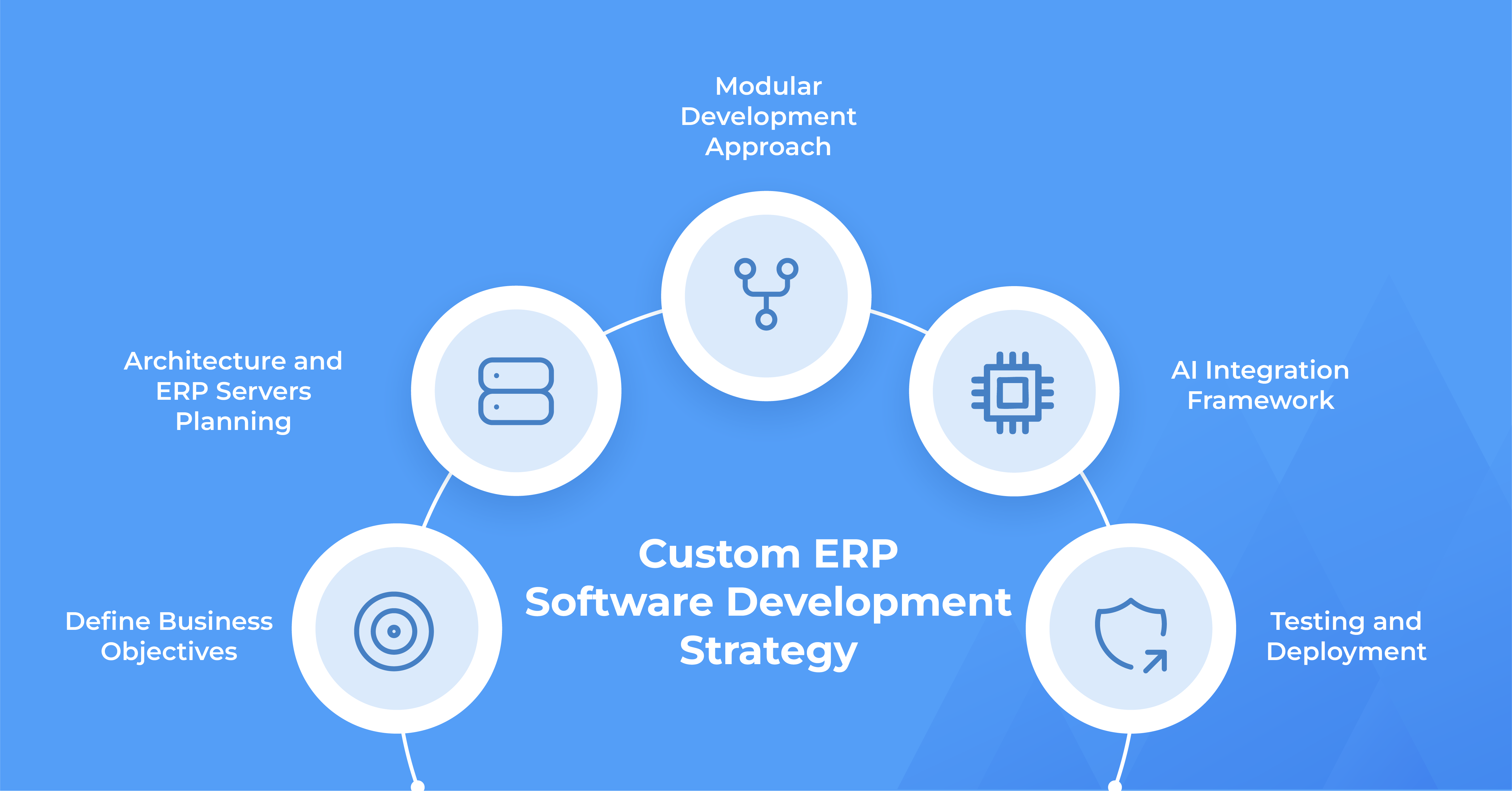
A successful custom ERP software development approach requires structured planning and scalable engineering aligned with long-term enterprise digital transformation goals.
Define Business Objectives
Identify operational bottlenecks, automation gaps, and scalability requirements before development begins.
Architecture and ERP Servers Planning
Design secure ERP servers architecture — whether on-premise, hybrid, or cloud-based. Infrastructure must support performance, compliance, data security, and future expansion.
Modular Development Approach
Custom ERP development should follow a modular strategy, enabling independent scaling of finance, HR, supply chain, and analytics components without system-wide disruption.
AI Integration Framework
Embed AI-driven ERP systems capabilities early to enable intelligent automation, predictive reporting, and business process optimization.
Testing and Deployment
Ensure rigorous performance testing, security validation, integration checks, and structured data migration before launch.
ERP System SaaS Development vs On-Premise ERP Servers
Enterprises today often choose between traditional ERP servers and ERP system SaaS development models depending on compliance requirements, IT maturity, and growth strategy.
ERP Servers (On-Premise)
- Greater infrastructure control
- Higher initial capital investment
- Dedicated in-house management
ERP System SaaS Development
- Cloud-native scalability
- Lower upfront costs
- Continuous updates
- Faster deployment
Real-World Impact of Custom ERP Software Development
When executed strategically, custom ERP software development delivers measurable operational improvements. Examples across industries include:
- Manufacturing: Reducing procurement cycle times by up to 25% through automated workflows.
- Retail: Improving demand forecasting accuracy using AI-driven ERP systems.
- Finance: Automating reconciliation processes and minimizing reporting errors.
- Logistics: Achieving unified visibility across multi-regional operations.
Common Challenges in Custom ERP Development
While powerful, custom ERP development requires careful execution to avoid common pitfalls:
- Poor requirement analysis
- Overcomplicated architecture
- Inadequate ERP servers capacity
- Weak AI integration strategy
- Insufficient data migration planning
Benefits of Custom ERP Software Development for Enterprises
Organizations investing in custom ERP development gain centralized visibility across finance, supply chain, HR, and customer operations — forming the digital backbone of enterprise transformation.
For commerce-driven businesses, ERP systems become even more powerful when integrated with ecommerce business intelligence strategies that turn operational data into actionable insights.
When AI-driven ERP systems are implemented strategically, enterprises unlock productivity gains similar to those seen with AI agents driving business productivity in modern enterprises.
From Custom ERP Development to Intelligent Enterprise Ecosystem
ERP is no longer just a back-office system. Through structured custom ERP software development, organizations build an integrated digital foundation that supports analytics, automation, and long-term innovation.
With scalable ERP servers or ERP system SaaS development models, businesses can expand globally without operational disruption. Custom ERP development enables enterprises to move from fragmented systems to unified, intelligent platforms that drive measurable efficiency, stronger governance, and sustainable growth.
Frequently Asked Questions
What is custom ERP software development?
Custom ERP software development is the process of building a tailored enterprise resource planning system aligned with specific business processes, scalability goals, and industry requirements.
How does custom ERP development differ from off-the-shelf ERP?
Custom ERP development provides tailored functionality, scalability, and integration flexibility, unlike generic ERP solutions which often require the business to adapt to the software.
What are AI-driven ERP systems?
AI-driven ERP systems integrate machine learning and predictive analytics into ERP platforms to automate processes and improve decision-making.
What is ERP system SaaS development?
ERP system SaaS development refers to building cloud-based ERP platforms delivered as a service, offering scalability and lower infrastructure costs.
Are ERP servers still relevant?
Yes. ERP servers remain relevant for organizations requiring strict data control, compliance requirements, and on-premise infrastructure.